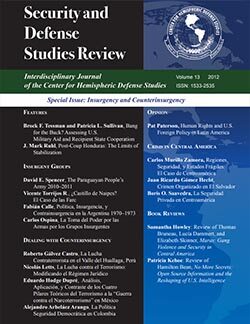
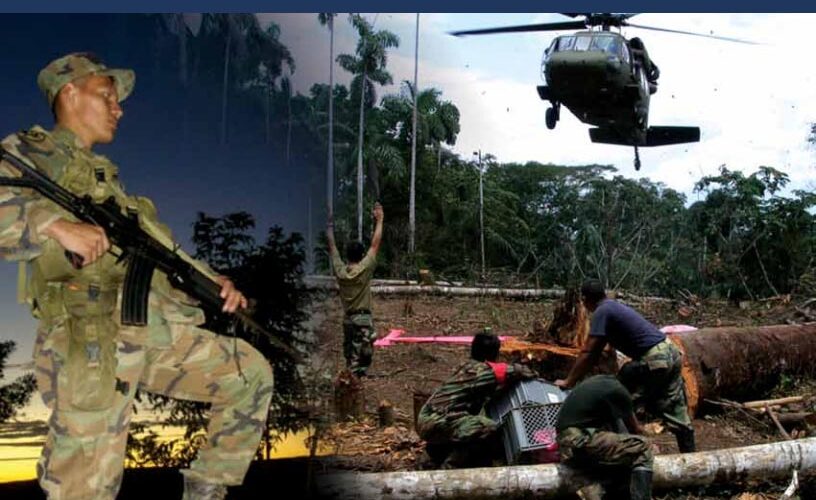
Using the concepts of resilience and complex networks, this paper explores the strategic behavior of the Revolutionary Armed Forces of Colombia (FARC) and elaborates a map that contributes to the broad reflection on the sustainability of illegal armed organizations.
Read more
The little press, analysis and debate regarding the 1970-1973 insurgency and counterinsurgency could be explained by the impact that this period would have on the linear and nuanced narratives that the "two sides" of the Dirty War have created throughout the period beginning in 1976. Paradoxically, one of the few, if not the only, consensuses among the protagonists of the Argentine drama is based on the silence or omission of the years studied in this essay. This is a subject that has and will have for many years to come a set of passions, ideological struggles and crossed and irreconcilable positions. It is not possible to vindicate or surreptitiously relativize the abyss of violence and cruelty into which our country fell almost four decades ago. This study will explore the events of the 1970s in Argentina in close collaboration with previous studies of criticism from both sides of the conflict between the government and insurgent groups.
Read more
Does US military aid buy recipient state compliance? In this study, we systematically investigate the effects of U.S. military assistance on recipient state behavior toward the United States. We present and test three different models—Arms for Influence, Lonely Superpower, and Reverse Leverage—that might capture the relationship between military aid and recipient state cooperation. Using innovative events data that measure cooperation between the United States and recipient states between 1990 and 2004, we test seven hypotheses using a combination of simultaneous equation, cross-sectional time series, and Heckman selection models. We find, with limited exceptions, support for the Reverse Leverage model: increasing levels of US military aid significantly reduce cooperative foreign policy behavior with the United States. U.S. reaction to recipient state behavior is also counterintuitive; our results show that recipient state cooperation is likely to lead to subsequent reductions in US military assistance, rather than proving the theory of success based on a carrot and stick approach.
Read more
The June 2009 military coup that ousted democratically elected President Manuel Zelaya resulted in the international isolation of the interim successor government of Roberto Micheletti and months of political turmoil that did not subside until after the election of current President Porfirio Lobo in November 2009. Honduran politics have stabilized in some important respects since Lobo's inauguration: The economy has slowly recovered, and the 2011 Cartagena Accord signed by Lobo and Zelaya has politically reintegrated the leftist former president via his new Liberty and Refoundation Party (LIBRE) and reinstated Honduras in the Organization of American States (OAS). However, Honduras' reconstructed democracy is fragile. Rising crime and unrelieved poverty have decimated President Lobo's approval ratings and encouraged widespread distrust of democratic institutions. To the extent that Zelaya's LIBRE is able to capitalize on this discontent in the upcoming 2013 elections, these institutions will be seriously tested.
Read more
The Perry Center has published a fiscal year (FY) Annual Report since 2011. Each report covers the educational programs, outreach activities, and achievements of the Center that occurred throughout the year. The Annual Reports serve as a foundational primer on who we are, what we do, and the impact we have in the Western Hemisphere.
Read more
In the last two years, the violence and visibility of the conflict between the Paraguayan State and the Paraguayan People's Army (EPP) has escalated significantly, due to the appearance of new weapons, tactics, and increasing involvement of foreign advisers on both sides as each has adapted to gain advantage over the other. Although the nature of the EPP has become somewhat clearer, many areas still need to be better understood in order for the Paraguayan state to effectively defeat this threat, which it can still do at relatively low cost if it adopts the right strategy and takes appropriate action. This article provides some of that understanding by identifying the events and breakthroughs which occurred in roughly two phases: government offensive (2010) and EPP adaptation (2011). The author concludes that groups such as the EPP are not merely police/justice problems, but state problems, and the most successful states are those that recognize this early and employ all the elements of national power to deal with the problem not only to reduce or eliminate the violence, but to prevent its regeneration.
Read more
The collapse of the Soviet Union is the most important strategic inflection that consolidates the era of transformation towards democracy in the world. In Latin America, the changes towards democracy were dramatic and irreversible. In this order of ideas, the opening created by the privatization process as a result of the third wave of democratization in Latin America, together with globalization, have emphasized the role of the State in its responsibility to provide the security and defense that allows the exercise of democracy and development. In Central America, the privatization of security has occurred as a consequence of the pacification process at the end of the 1980s, democratization and globalization. In this order, the State has shown itself incapable of providing the common good of security. This essay aims to analyze the state of control and supervision of the privatization of security and defense in Central America and its impact and trends in the current security environment in the region.
Read more