
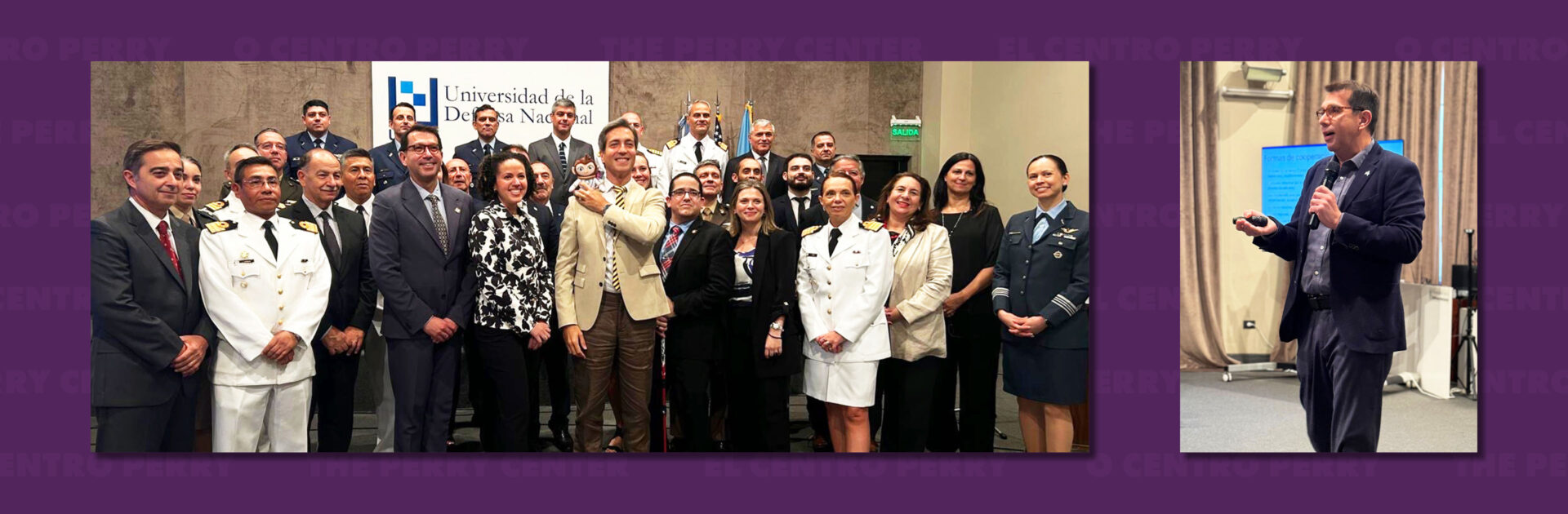
From March 4 to 20, 2026, the William J. Perry Center for Hemispheric Defense Studies partnered with Argentina’s National Defense University (UNDEF) to deliver the course Space Strategy and Policy in Buenos Aires, strengthening strategic understanding of the space domain among Argentine defense and security professionals. The program brought together Argentine military officers, civilian defense officials, and public policy professionals responsible for space-related policy, capability development, and operational design.
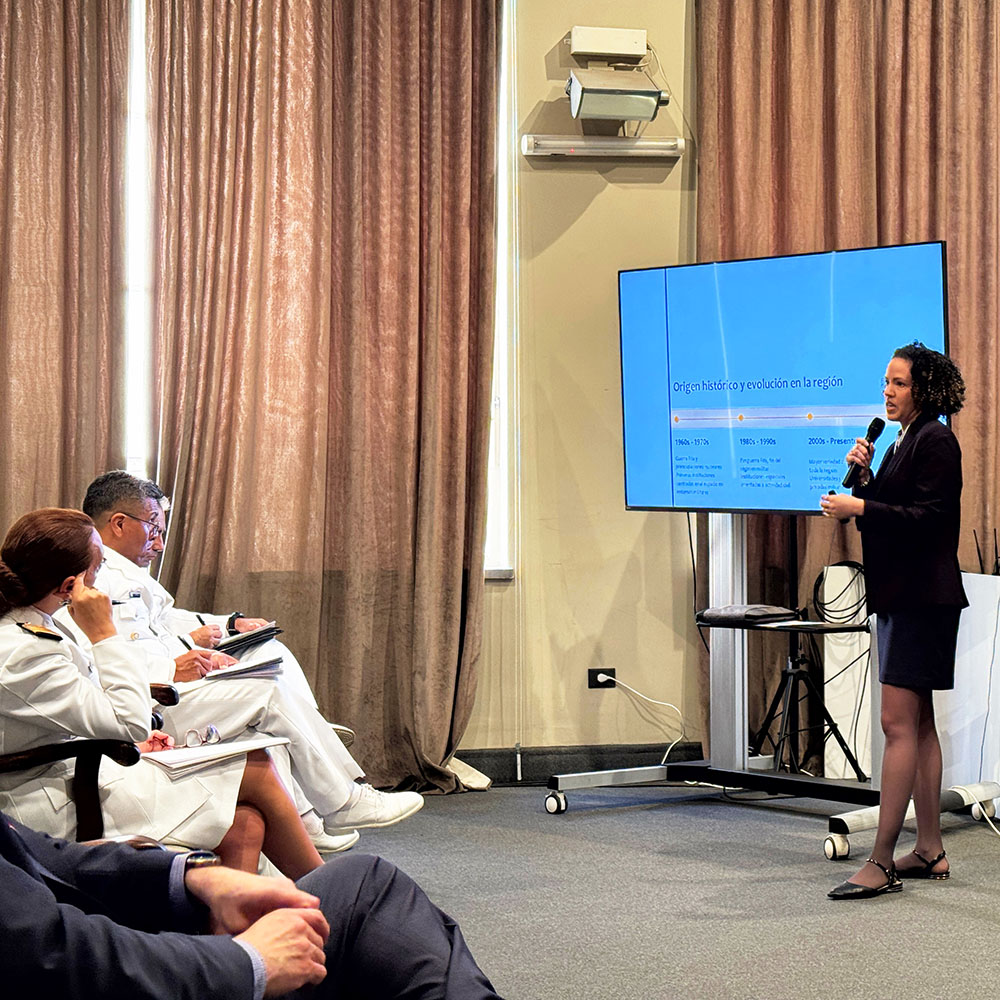
Laura Delgado López (R) and course participants
Arturo Sotomayor, Perry Center Professor, along with Verónica Mulle, UNDEF’s Academic Dean, and Gonzalo Salimena, UNDEF’s Director of Undergraduate Studies, coordinated the program and framed outer space as a multidimensional domain spanning military, diplomatic, economic, and technological spheres shaped by innovation and private-sector actors. Participants analyzed US national interests in space, examined the recognition of space as a warfighting domain, assessed China’s expanding space program, and evaluated Argentina’s national space architecture. The curriculum drew on classical strategic thought – from Sun Tzu to Clausewitz – to frame contemporary debates on deterrence, competition, and escalation in space.
Faculty aligned the course with key US strategic documents, including the 2025/2026 National Security Strategy, the 2026 National Defense Strategy, the 2018 National Space Strategy, and the Artemis Accords, along with Argentina’s National Space Plan. Through comparative analysis, participants evaluated doctrinal and institutional models for organizing national space capabilities, emphasizing resilience, deterrence, and allied integration. Heriberto Acosta-Maestre, Perry Center Cyber Policy Fellow, and Laura Delgado López, space analyst, facilitated discussions and guided participants through practical exercises.
Throughout the course, the faculty combined expert lectures, policy analysis, and experiential learning. Participants built a foundation in space governance, legal regimes, and strategic competition, then applied those frameworks to Argentina’s national context through interactive simulations and strategy design exercises. Discussions bridged civilian and military perspectives and connected theory to professional practice.