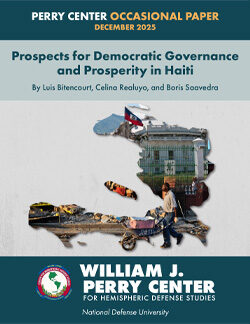
Haiti faces a severe collapse of security, governance, and economic stability as gangs expand territorial control, state institutions weaken, and humanitarian needs escalate. The paper analyzes the limited effectiveness of past international interventions and describes how new UN Security Council Resolutions 2793 and 2794 aim to empower a larger Gang Suppression Force and strengthen sanctions to curb armed groups and illicit financial flows. It details how corruption, money laundering, and diversified criminal financing - combined with an under-resourced police and judiciary - undermine efforts to restore order. The authors argue that only a coordinated, Haitian-led strategy integrating security operations, institutional reform, and international support can create the conditions for long-term democratic governance and prosperity.
The article explores the US Marine Corps' (USMC) Force Design 2030 and its potential to enhance multinational joint defense capabilities in the Americas. It argues that traditional military strategies are inadequate for modern security challenges, such as transnational crime and irregular warfare. By promoting interoperability, standardized training, and shared platforms, the USMC seeks to strengthen collective defense across the region. The article highlights the growing importance of naval and maritime forces, examines geopolitical threats, and suggests that Latin American nations can benefit from adopting elements of the Force Design 2030 to enhance security and stability.
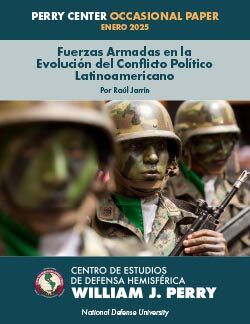
Ecuador is in the midst of an intense security crisis, one that pits the government and its security forces against well-armed violent gangs. Former Ecuadorian Minister of Defense General Raul Jarrin examines the situation through an operational lens as well as the geopolitical scholarship on democracy, the role of the state, and the rule of law.
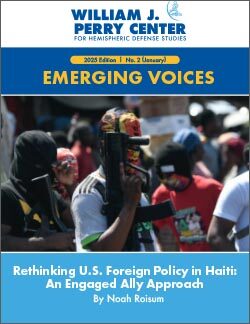
Haiti is in a state of chaos. It is ravaged and controlled by vicious gangs caught in a turf war, that terrorize, abuse, and murder at whim. Ultimately, Haiti, on the brink of state failure, will not recover until its internal security crisis and lack of good, legitimate governance are remediated. The United States should pursue a multifaceted "engaged ally" approach to address the underlying security and socio-economic issues to lead to long-term, positive change in Haiti. This approach acknowledges the unique capacity of the United States and its allies to bring about change in Haiti while still prioritizing a Haitian-led solution.
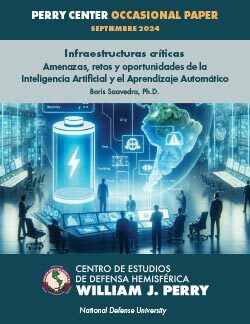
This article examines the threats and challenges of cybersecurity in Latin America and the Caribbean to include the protection of critical infrastructure in cyberspace and the implications for daily human interaction and survival. The article objective is to analyze politically and strategically critical infrastructures in Latin America and the Caribbean in light of generative AI, Meta Data Analytics and machine learning (ML). The report provides an analysis at a political and strategic level of the current technological environment characterized by the aforementioned accelerated exponential and convergent processes which have generated disruptive innovations. All this set of facts impacts humanity in general and critical infrastructures, a fundamental factor for life on the planet.