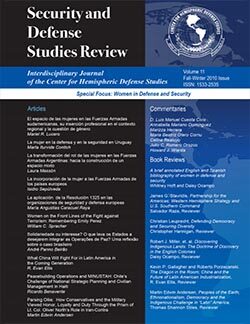
The permanent evolution of the relationship between states and the complexity of intra-state conflicts, challenges to innovate in security and defense policies from the position of international organizations, political will of member countries, in addition to the incorporation of other actors for cooperation and institutionalization of solutions to instability. Under this condition, the role of women is paramount, since from the classic concepts of specific functions and perfect society to their victimization in the latest humanitarian tragedies, their role should be more strongly inscribed in the construction of society through certain elements: their protagonism, product of effective public policies of national, regional and global scope, translated into robust and comprehensive institutions.
Read more
This presentation was made at the Center for Hemispheric Defense Studies (CHDS) Conferencia Subregional para Meso-America, San Salvador, El Salvador, July 20-23, 2010.
Read more

More than two decades after Oliver North's role in the Iran-Contra affair exploded into public view as part of one of the most important political scandals in the United States in the latter half of the twentieth century, the imbroglio continues to offer critical insights into contemporary debates about foreign policy mechanisms and the role of the military. North's responsibility as an individual, combined with certain institutional enablers that flourished within the Reagan Administration's conduct of foreign policy, resulted in an inexorable bifurcation between the traditional ethos of the U.S. armed forces and the foreign policy aims and practices of a conservative administration, despite their sometimes conflation in the popular mind. This paper will explore the tensions between institutional versus political conservatism, as well as those institutional practices, that facilitated North's shift away from the instincts and training of the military sphere to that of a lone-wolf activism.
Read more