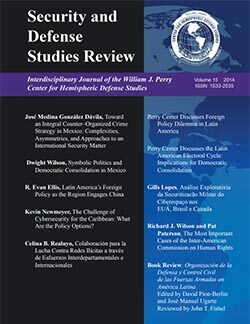
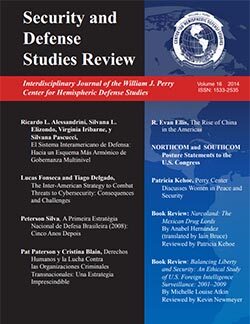
This article examines the expansion of economic, political, and military activities by the People's Republic of China in Latin America and the Caribbean. It examines how the presence is transforming the region, including the reformulation of the agenda of its leaders, businessmen, and publics, changes to its physical infrastructure, new patterns of trans-Pacific organized crime, fuel to extend the life of populist regimes, and impacts on how member countries relate to each other. It also analyzes how the new presence of China impacts US interests in the region and globally, and how China both complements, and at times competes with, other external actors in the region, such as Russia, Iran, and India.
Read more
This article provides an overview of the Inter-American Strategy to Combat Threats to Cybersecurity, highlighting the roles and responsibilities of the various stakeholders, including governments, international organizations, the private sector, and civil society. The article emphasizes the recent success achieved by this international arrangement by observing the increase in the number of national Computer and Security Incident Response Teams (CSIRTs) in America, as well as the intent to create a regional cybersecurity culture in partnership with the private sector and civil society and the cooperation between law agencies throughout the continent.
Read more
For a special report on the Commission, the Perry Center Publications Editor-in-Chief Patrick Paterson met with Professor Richard Wilson, Director of the International Human Rights Law Clinic at the Washington College of Law, to discuss the most important cases or reports in the history of the Commission. Professor Wilson, a frequent lecturer at the Perry Center, is a longtime observer of the Commission and Court, where he and his students have presented more than 30 cases. Of the thousands of cases and reports of the Commission, Professor Wilson selected a few that he thought were especially important or influential.
Read more
This paper addresses some of the policy issues affecting cybersecurity in the Caribbean and how best to respond to those challenges. International organizations such as the International Telecommunications Union and the Organization of American States called for all states in the region to develop national cybersecurity strategies to protect their critical infrastructure, business interests, and private citizens. The Caribbean states have lagged in establishing national cybersecurity strategies. The challenge for Caribbean states and other developing nations remains how best to protect their security and economic interests in a connected environment. Which strategic paradigm fits the culture and the capabilities of such nations? This paper examines the threat and the various alternative frameworks to respond to the growing cyber threat including national security, economic, and public health approaches to cybersecurity.
Read more
In September 2013, the William J. Perry Center for Hemispheric Defense Studies conducted a Hemispheric Forum on US foreign policy in Latin America. The forum, one of a series of conferences that bring distinguished scholars together to discuss matters of urgency in the Hemisphere, addressed the dilemma faced by US policy makers in the current political environment in Latin America and the Caribbean. Panelists remarked on the political relations between the United States and Latin American nations, relations that have grown distant and contentious in the last decade. A summary of the discussion is provided for readers.
Read more
In December 2013 as part of a series of Hemispheric Forums, the William J. Perry Center hosted a round table discussion of democracy in Latin America. In particular, the group analyzed recent and upcoming elections in the Americas, events that might reflect the political uncertainty common in the region. The panelists included a number of subject matter experts on Latin American politics and democracy: Johanna Mendelson Forman, Senior Associate, Program on Crisis, Conflict and Cooperation at the Center for Strategic and International Studies; Roberto Izurieta, Director of Latin American Projects for the Graduate School of Political Management (GSPM) at George Washington University; and Harold Trinkunas, Charles W. Robinson Chair and Senior Fellow and Director of the Latin America Initiative at the Brookings Institution. Luis Bitencourt, Dean of Academics at the Perry Center, moderated the panel.
Read more