
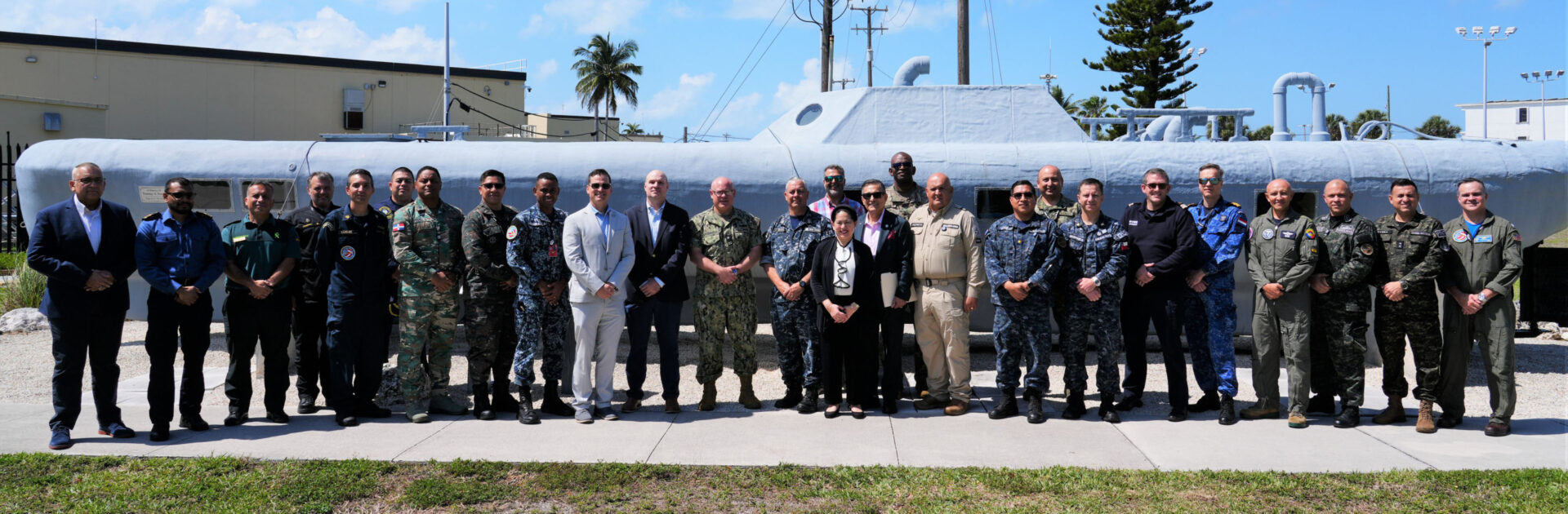
From March 25 to 26, 2026, the William J. Perry Center for Hemispheric Defense Studies partnered with the Joint Interagency Task Force South (JIATF-S) to deliver a professional development seminar for Foreign Liaison Officers (FLOs) and US Government personnel. The seminar brought together 68 participants representing 21 countries: Argentina, Belize, Brazil, Canada, Chile, Colombia, Costa Rica, Dominican Republic, Ecuador, El Salvador, France, Guatemala, Honduras, Jamaica, Mexico, the Netherlands, Panama, Spain, Trinidad and Tobago, the United Kingdom, and the United States. Among the participants were five Perry Center alumni, reinforcing sustained engagement with the institution’s regional network. The Perry Center delegation included Dean of Academic Affairs William Godnick and Professors Boris Saavedra, Celina Realuyo, and Eric Driggs, who led the academic program.
The program strengthened partnerships across the Western Hemisphere by investing in the professional education of international officers expected to assume future leadership roles in their respective countries. It also supported the JIATF-S International Affairs Division’s request for continuing education.
JIATF-S hosted the Perry Center delegation, with Rear Admiral Jeffrey Jurgemeyer, providing senior-level engagement and support for the program. The agenda also included official engagements with JIATF-S leadership and direct interaction between participants and US counterparts, further strengthening institutional relationships and advancing hemispheric security cooperation.
Perry Center faculty delivered a curriculum focused on key transnational security challenges, including the US national security strategy and national defense strategy; cyber domain and emerging technologies; illicit arms trafficking; illegal, unreported, and unregulated fishing; critical infrastructure and national security; illicit finance and transnational criminal organizations; and the evolving fentanyl threat in both the United States and Latin America. Faculty-aligned discussions with US strategic priorities while emphasizing policy gaps and opportunities for cooperation with partner nations. The program ran parallel sessions in English and Spanish, followed by joint discussions supported by simultaneous interpretation to promote inclusive dialogue and shared understanding.
The seminar combined expert-led lectures with interactive discussions that encouraged participants to compare national approaches, identify shared challenges, and explore opportunities for collaboration. Sessions highlighted the intersection of security policy, emerging threats, and regional cooperation, reinforcing the importance of coordinated strategies to address complex transnational issues.
CONTACT INFORMATION