Food insecurity is an urgent problem in Latin America and the Caribbean (LAC), and the LAC region’s susceptibility to food insecurity is poised to worsen. Food insecurity is not in itself a phenomenon that necessitates a military response. Indeed, food insecurity is “not” a traditional security threat to territorial borders and national sovereignty. Rather, it should be seen as an amplifier of political, economic, social, and ecological strain and vulnerabilities that can be exploited by malign actors and, thus, contributing to heightened security concerns. In this view, investments in food security should be considered as necessary, proactive, and preventative security measures, in support of civilian government agencies and the private and nonprofit sectors. Through a limited role focused on humanitarian assistance, disaster response, and interagency and international collaboration, the United States can leverage the capacities and resources of the DOD to support its regional partners in combating food insecurity. Anything less would risk losing a strategic, humanitarian, and moral imperative.
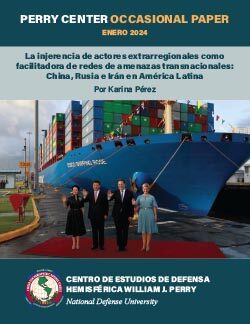
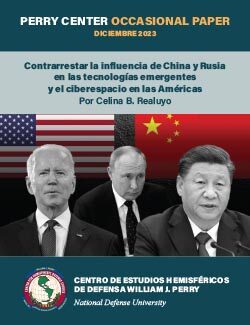
The interference of external antagonistic groups can destabilize and weaken States, while their operational networks are strengthened. Several factors facilitate the interference of actors such as China, Russia and Iran in Latin America. Facing these risks, some countries in the region, security institutions, and national and international organizations are collaborating to fight this external antagonism. Karina Perez’s paper proposes the idea of combating these threats by inhibiting the influence of external actors, analyzing the key factors that have favored their influence in Latin America, and how their presence has been linked to various transnational threats.
This document was created for the celebration of Perry Center AlumniDay, and its purpose is to share some of the bibliographic contributions published in 2023 by its graduates in various formats and modalities. They contribute to reflect, debate and research security and defense issues, evidencing the impact generated by the Perry Center within the framework of these issues at the national and regional level.
The evolution of global geopolitics has its center of gravity constituted by the emerging digital technology of exponential acceleration, which is based on the control or power of information and communications. When making a prospective emphasis to analyze the influence of emerging digital technology, it is observed that it is a bearer of the future through artificial intelligence technology, 5G communications and quantum computing.
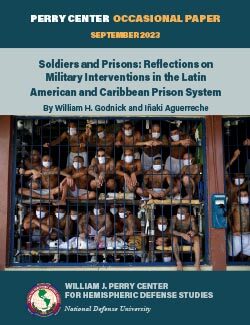
Authors William Godnick and Iñaki Aguerreche assembled a thorough investigation and analysis on the occurrence of military interventions in the prison system in Latin America and the Caribbean. This insightful portrayal of the reality of prisons in many countries is a must-read for anyone interested in understanding this problem in the region.
This Occasional Paper is an english-language translation of Godnick’s and Aguerreche’s research which originally appeared in Fuerza pública en América Latina: Sus retos y buenas prácticas a la luz de la democracia y los derechos humanos (Public Forces in Latin America: Challenges and Good Practices in the Light of Democracy and Human Rights), published by the University of Guadalajara Press in 2022.
Perry Center Research Associate Chase Boone worked on the English translation.