
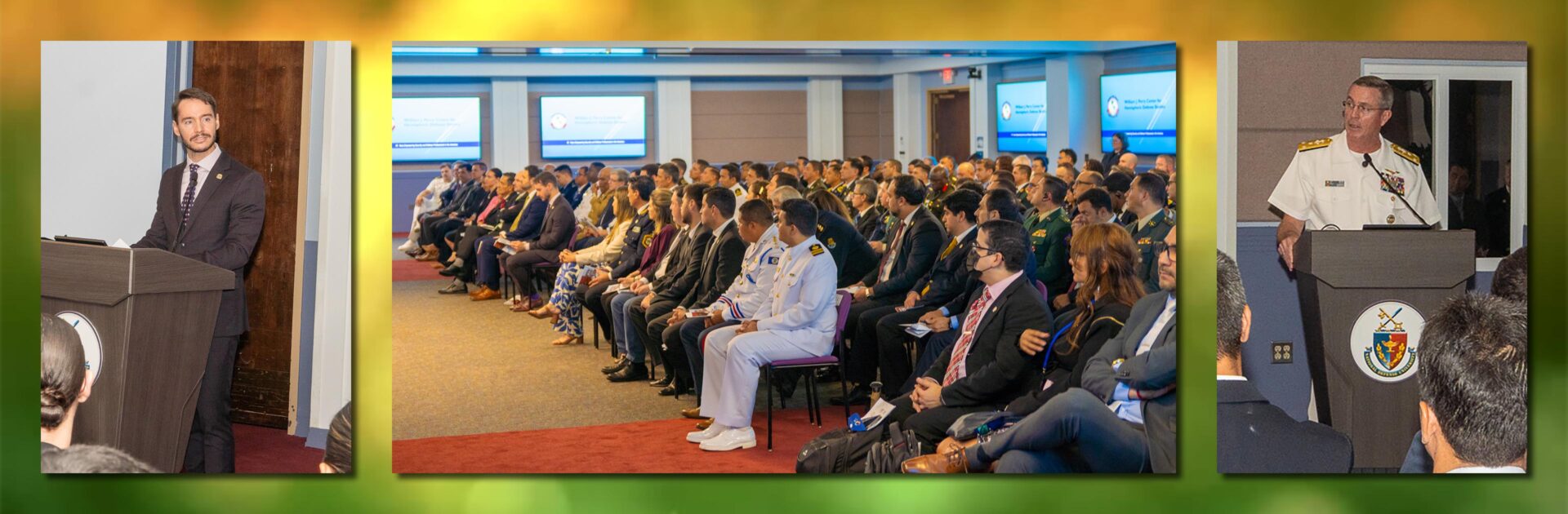
From September 15 to 26, 2025, the William J. Perry Center for Hemispheric Defense Studies hosted 117 participants from 23 countries for two concurrent in-residence courses: Cyber Policy Development and Artificial Intelligence Applications for Defense (CYBER-AI) and Combating Transnational Organized Crime: Borderlands (CTOC-B).
CYBER-AI, directed by Perry Center Professor Dr. Boris Saavedra, examined cyber governance at the intersection of politics, strategy, and technology. With an emphasis on generative AI as both a competitive asset and a potential vulnerability, the program equipped participants to strengthen policymaking, decision-making, and interagency cooperation in cyberspace. Through lectures, group discussion, and simulation exercises, participants assessed the region’s exposure to ransomware, disinformation, and AI-driven attacks, while also exploring opportunities to reinforce democratic governance, protecting critical infrastructure, and advancing public–private partnerships.
The Countering Malign Influence workshop, led by Perry Center Research Associate Sydney Knapp, took place September 17 – 19 as an integral part of the in-residence phase of the CTOC-B course. Over three days, participants studied how the People’s Republic of China and other malign actors employ hybrid tactics in the maritime, cyber, legal, and economic domains. Case studies on critical infrastructure, financial coercion, and maritime insecurity offered practical tools to analyze hybrid warfare, strengthen countermeasures, and reinforce regional defense cooperation.
CTOC-B, directed by Perry Center Professor Celina Realuyo and co-sponsored with the Irregular Warfare Center, brought together civilian and military officials from across the Americas and US government representatives for an intensive week focused on the defense and security challenges of border regions. The course addressed how illicit networks exploit migration flows, contraband, narcotics trafficking, and arms smuggling, along with the risks of terrorist infiltration. Through case studies and a culminating group exercise, participants evaluated current approaches. They designed innovative strategies to improve governance, interagency collaboration, and operational coordination against transnational organized crime along maritime and land borders.
Perry Center Director Dr. Paul J. Angelo congratulated the participants during the graduation ceremony. He underscored, “Those of us responsible for safeguarding the national security of our countries must not only ask ourselves how to respond to each threat, but also how to recognize its interconnections and anticipate our adversaries’ next moves.” Vice Admiral Peter Garvin, President of the National Defense University, joined Dr. Angelo in delivering remarks.
The Perry Center extends sincere appreciation to the course directors — Dr. Boris Saavedra (CYBER-AI) and Professor Celina Realuyo (CTOC-B); to facilitators Dr. Heriberto Acosta-Maestre, Angélica Castillo, Gianncarlo Gómez Morales, and Diego Rodríguez (CYBER-AI); Brigadier General (ret.) Juan Carlos Gómez, CDR (ret.) Eric Driggs, Dr. Tom Searle, and Sydney Knapp (CTOC-B). Likewise, the Perry Center appreciates the contributions of Deputy Assistant Secretary of War Joseph Humire and Irregular Warfare Center Director Dr. Dennis Walters to the success of these courses.
CONTACT INFORMATION