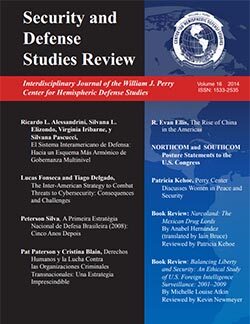
Latin American governments have had to turn to their military forces to combat organized crime. The military, highly respected in most Latin American nations, has the discipline and the power of arms to counter these groups. However, the use of the military in police operations is a dangerous solution. Soldiers without adequate training or education could commit human rights violations and jeopardize the legitimacy of the military institution in the eyes of civil society. The US experience in Iraq demonstrates the risks of deploying armed forces that lack proper training. Used incorrectly, this force can be counterproductive and can jeopardize the most important strategic objective: the support of the population. Respect for human rights generates legitimacy that leads to collaboration and citizen support and intelligence opportunities for military forces.
Read more
The Perry Center has published a fiscal year (FY) Annual Report since 2011. Each report covers the educational programs, outreach activities, and achievements of the Center that occurred throughout the year. The Annual Reports serve as a foundational primer on who we are, what we do, and the impact we have in the Western Hemisphere.
Read more
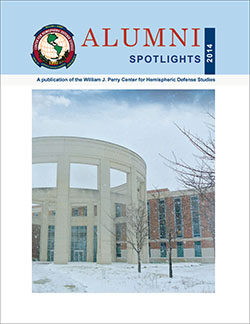
The Alumni Spotlights magazine is an annual publication which highlights the experiences and achievements of alumni of the William J. Perry Center for Hemispheric Defense Studies and demonstrates the exceptional impact its alumni are making around the world. Individual spotlights are also featured on our web site and social media pages.
Read more
As part of the commands' annual posture statements to Congress, General John Kelly of SOUTHCOM and General Charles Jacoby, Jr. of NORTHCOM presented their goals and concerns in testimony before the House and Senate Armed Service Committees on February 26, 2014 and March 13, 2014, respectively. The Perry Center, as one of the Hemisphere's premier venues for security and defense education and outreach, plays a pivotal role in carrying out both NORTHCOM and SOUTHCOM's priorities throughout the year. The following summaries of Gen. Kelly's and Gen. Jacoby's 2014 posture statements provide insight into the key concerns and objectives for the Western Hemisphere regional commands over the course of the year.
Read more
This article examines the expansion of economic, political, and military activities by the People's Republic of China in Latin America and the Caribbean. It examines how the presence is transforming the region, including the reformulation of the agenda of its leaders, businessmen, and publics, changes to its physical infrastructure, new patterns of trans-Pacific organized crime, fuel to extend the life of populist regimes, and impacts on how member countries relate to each other. It also analyzes how the new presence of China impacts US interests in the region and globally, and how China both complements, and at times competes with, other external actors in the region, such as Russia, Iran, and India.
Read more
The Inter-American Defense System can be analyzed as regional security governance, in which mechanisms and practices of different levels and scopes coexist and overlap in time, space and function. The objective of this article is to study how this overlapping has affected the provision of security in successive historical contexts and what is the current situation, based on a functional approach. To this end, the performance of mechanisms related to collective security (56 conflicts) and cooperative security (5 issues) will be examined, identifying the dynamics between the different levels. This analysis will lead to the conclusion that, since the creation of UNASUR, the overlapping of mechanisms has shifted from a cooperative interaction to a complex one, in which competitive tendencies are reinforced. Based on this, the design of a better articulated governance that reflects the leading role of the regions as providers of security within the hemispheric system is proposed.
Read more
This article provides an overview of the Inter-American Strategy to Combat Threats to Cybersecurity, highlighting the roles and responsibilities of the various stakeholders, including governments, international organizations, the private sector, and civil society. The article emphasizes the recent success achieved by this international arrangement by observing the increase in the number of national Computer and Security Incident Response Teams (CSIRTs) in America, as well as the intent to create a regional cybersecurity culture in partnership with the private sector and civil society and the cooperation between law agencies throughout the continent.
Read more