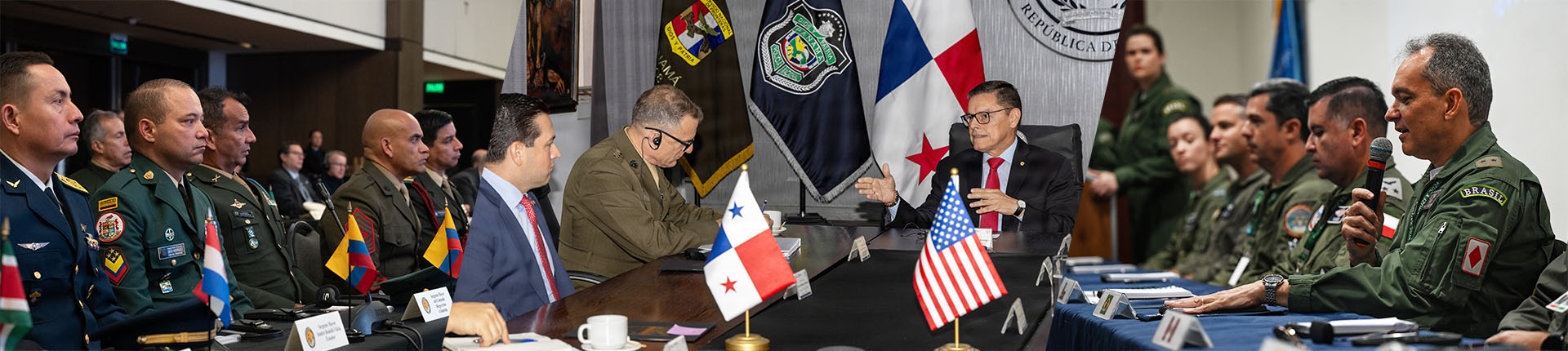
Governance and Strategy for Security and Defense (GSSD) is a four-week course (two weeks distance-learning and two weeks in-residence) designed to stimulate critical thinking on the requirements to produce effective, efficient, and transparent management of security and defense establishments in a democratic environment. The course is designed to encourage healthy civil-military relations and interagency cooperation to combat shared threats to hemispheric security, including transnational organized crime, malicious cyber activity, and grey-zone activities. GSSD begins with a survey of the theoretical underpinnings of the roles and responsibilities of security and defense establishments in democratic societies and addresses the overall strategic context in the Western Hemisphere today. It then focuses on four important pillars for defense and security policy making: policy writing, strategic planning, institutional reform, and resource management.
Consistent with the broader goal of improving security and defense governance within a democratic framework, GSSD aims to:
All participants must successfully complete a course writing assignment that may take the form of an essay, policy paper, action plan or similar.
This course is designed for late early and mid-career officials with roles related to security and defense policy making and strategy implementation (O-4/O-5 and their civilian equivalents). Ideally, participants should be from one of the following communities:
In accordance with Department of Defense policy, citizens of “high income” countries (as established by the World Bank) are not eligible for scholarships. As of 01 July 2025, this restriction applies to the following Western Hemisphere nations and territories:
Citizens of these countries may still apply to courses, but in a fully self-funded status. Self-funded candidates must meet all eligibility standards and comply with all application requirements, including application deadlines, as well as being able to cover the expenses of their own travel, lodging, meals, and incidentals. US citizens cannot (by law) receive scholarships, but may also apply to attend in a self-funded status. US citizens and other self-funded candidates should contact the Admissions Office for additional guidance.
Candidates must possess a university degree or, in cases where a candidate does not hold a degree, equivalent practical experience. Military and police personnel must have completed a command and staff course or equivalent. Exceptions are evaluated on a case-by-case basis.
This course is conducted in Spanish. Non-native speakers must demonstrate the ability to speak and write in Spanish at a bilingual level prior to acceptance and enrollment.
CONTACT INFORMATION