
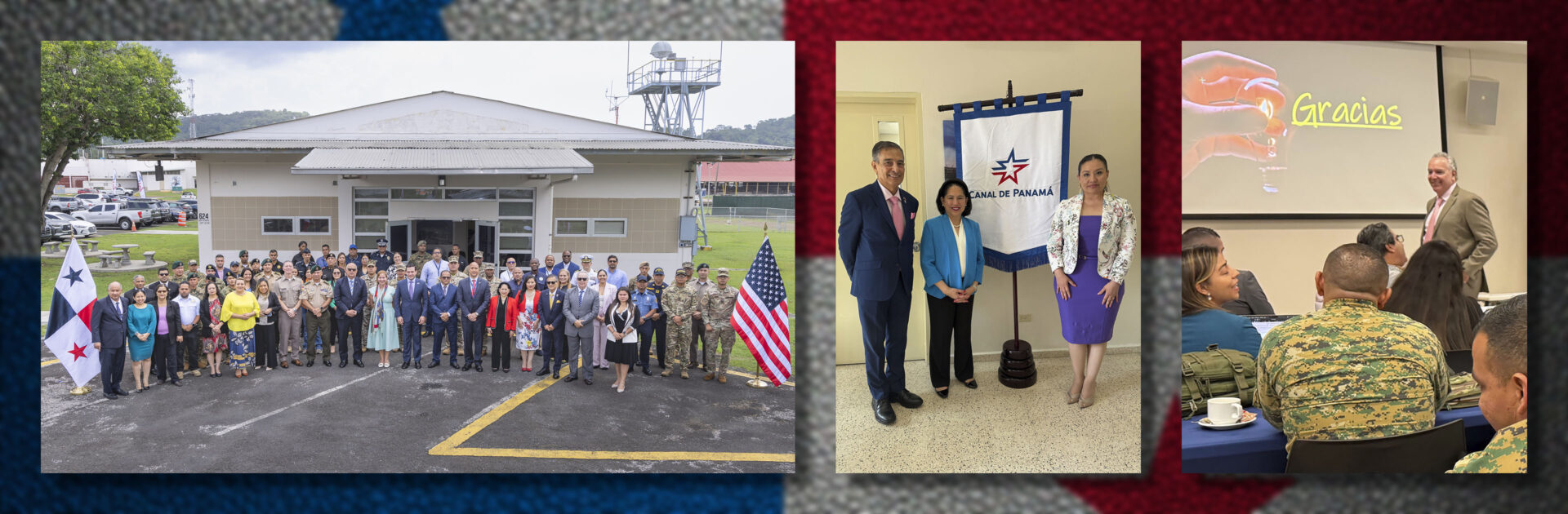
From May 12 to 14, 2026, the William J. Perry Center for Hemispheric Defense Studies conducted the Countering Hybrid Threats in the Americas mobile course at the Panama Canal Authority headquarters in Panama City, bringing together 60 participants from Panama’s interagency security and defense institutions. US Ambassador to Panama Kevin Cabrera and Panama’s Vice Minister of Public Security Luis Felipe Icaza inaugurated the course, underscoring the importance of bilateral cooperation to counter cartels, transnational criminal organizations, and hybrid threats affecting regional security and democratic governance.
The three-day program examined how hybrid threats originating from external state actors such as China, Russia, and Iran, as well as non-state actors including terrorist and criminal organizations, seek to undermine security, prosperity, and democratic institutions in the Americas across the cyber and physical domains. The curriculum emphasized interagency and international approaches to countering these threats while analyzing the evolving strategic environment facing Panama and the broader Western Hemisphere.
Perry Center Professors Celina Realuyo and Boris Saavedra directed the course with the support of WJPC alums and visiting professors Yadira Gálvez and Ricardo Gómez Hecht. Faculty and regional experts explored global, regional, and national security dynamics from both Panamanian and US perspectives, framing the operational and strategic challenges posed by hybrid actors in the hemisphere. Discussions highlighted the convergence of terrorism and organized crime, the role of extra-hemispheric actors, and the increasing use of cyber capabilities, disinformation, drones, and illicit financial networks to destabilize democratic societies.
Throughout the program, participants engaged in lectures and policy discussions focused on narcotrafficking, arms trafficking, irregular migration, human trafficking, cybersecurity, critical infrastructure protection, maritime security, artificial intelligence and disinformation, and anti-money laundering and counterterrorism financing strategies. Faculty also emphasized the importance of interagency coordination and international cooperation in addressing complex transnational threats. The course connected strategic analysis with operational realities facing Panama and regional partners, fostering dialogue among civilian and military professionals responsible for security, defense, and public policy.
CONTACT INFORMATION