
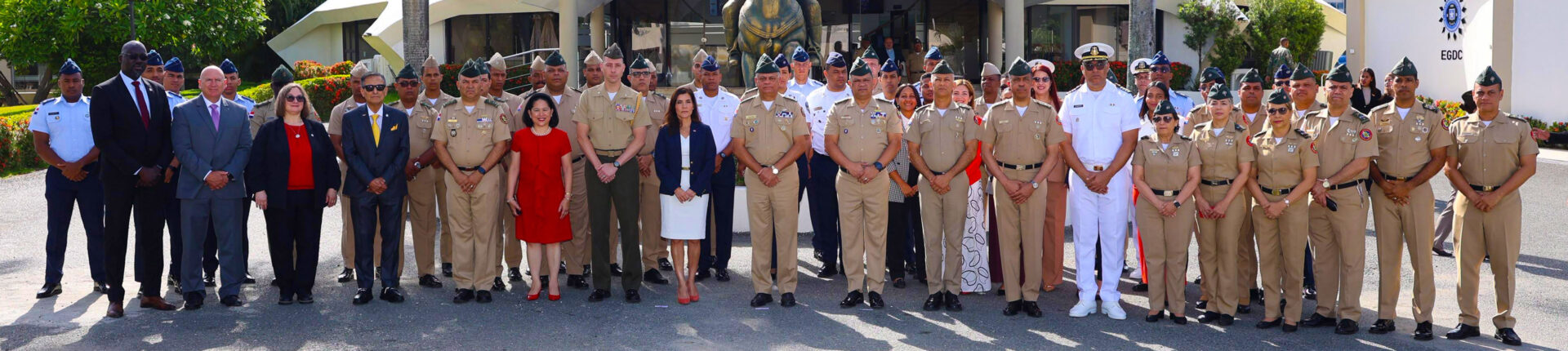
Del 23 al 25 de junio de 2026, el Centro de Estudios de Defensa Hemisférica William J. Perry realizó el curso móvil sobre Amenazas Híbridas en coordinación con el Ministerio de Defensa de la República Dominicana (MIDE) y la Universidad Nacional para la Defensa “General Juan Pablo Duarte y Díez” (UNADE), en Santo Domingo, República Dominicana. El curso reunió a 42 participantes del Ministerio de Defensa, de la Policía Nacional y del Ministerio de Relaciones Exteriores de la República Dominicana. La ceremonia de inauguración estuvo encabezada por la embajadora de los Estados Unidos en la República Dominicana, Leah Francis Campos, y el ministro de Defensa, teniente general Carlos Antonio Fernández Onofre, ERD, quienes destacaron la importancia de fortalecer la cooperación bilateral para enfrentar el crimen organizado transnacional, los cárteles y otras amenazas híbridas que afectan la seguridad y la estabilidad regionales.
Durante los tres días del programa se analizó cómo las amenazas híbridas provenientes de actores estatales externos – entre ellos China, Rusia e Irán – y de actores no estatales, como organizaciones terroristas y criminales, buscan debilitar la seguridad, la prosperidad y las instituciones democráticas en todo el continente americano, tanto en el ciberespacio como en el ámbito físico. El plan de estudios exploró estrategias y políticas para hacer frente a estos desafíos, en consonancia con la Estrategia de Seguridad Nacional (NSS), la Estrategia de Defensa Nacional (NDS) y la iniciativa Escudo de las Américas (Shield of the Americas).
Los profesores del Centro Perry, Celina Realuyo y Boris Saavedra, dirigieron el curso con el apoyo de expertos dominicanos en la materia, así como del personal del Centro Perry y de la UNADE. Los participantes analizaron el entorno estratégico actual y las implicaciones del crimen organizado transnacional, la influencia de actores extrahemisféricos y las amenazas híbridas desde las perspectivas de la República Dominicana y de los Estados Unidos. Asimismo, las discusiones abordaron la convergencia entre las redes criminales y terroristas, así como el creciente uso de operaciones cibernéticas, campañas de desinformación, inteligencia artificial, redes financieras ilícitas y otras tecnologías emergentes para desafiar la gobernanza democrática y la seguridad regional.
El programa abordó temas relacionados con la lucha contra las amenazas transnacionales, la ciberseguridad, la inteligencia artificial, la migración y la seguridad fronteriza, la seguridad territorial y marítima, la protección de infraestructuras críticas y el fortalecimiento de la resiliencia institucional. El cuerpo docente destacó la importancia de la cooperación internacional, la coordinación interinstitucional y el intercambio de conocimientos para desarrollar capacidades estratégicas que permitan responder eficazmente a los desafíos emergentes en materia de seguridad. El curso promovió el diálogo entre profesionales civiles y militares, fortaleció las relaciones de colaboración y mejoró la interoperabilidad entre las instituciones de seguridad de la República Dominicana y sus homólogas de los Estados Unidos.
INFORMACIÓN DE CONTACTO
National Defense University
Abraham Lincoln Hall
260 5th Avenue, Building 64
Washington, DC 20319-5066
Send us an e-mail