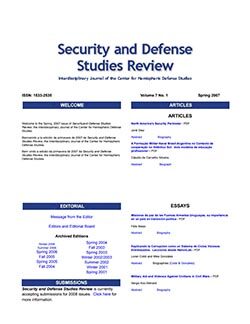
This paper covers a part of the post-doctoral research conducted by the author at UNESP-Franca in 2005. It is an analytical comparison between the military-naval education models developed in Brazil and Argentina within the context of the post-authoritarian regimes that are current nowadays. Also, two main aspects regarding professional training in both countries is dealt with within the context of any regional cooperation agreements and the Mercosur.
Read more
The attacks on the United States of September 11, 2001 changed dramatically the dynamic and nature of North American relations, igniting interest in closer cooperation among the three countries, especially on issues relating to security, border patrol and immigration. This renewed interest in strengthening collaboration in North America has crystallized into a call for the establishment of a "North American Security Perimeter." The three North American countries have taken several significant steps to strengthen collaboration on security matters. In effect, security cooperation within the continent has never been as strong, and it has in fact been institutionalized between Mexico and the US on some levels. Nonetheless, despite this new level of continental security cooperation, this article advances the argument that we are still far from the establishment of an international regime that would resemble anything close to a security perimeter. Instead, it is argued that what we are witnessing is the emergence of an informal North American security system that has unfolded along the two traditional axes that have historically characterized North American relations: the US-Canada relationship and the US-Mexico relationship.
Read more
This article deals with the significant role technological innovations play in the strengthening of Brazil's military capabilities, based on the qualitative nature of modern warfare, and any security issues that the nation faces in early 21st Century. Thus, it reviews the phenomenon that many authors call the RAM (Revolution in Military Affairs) of the nineties, resulting from the IT process of the combat means. But any political implications are more relevant than any mere operational issues of this RAM, to the extent that it provides a cost reduction for the nations that are at the forefront of the interventionism as an instrument of international action. However, it has also generated vulnerabilities, and improved the involvement of non-governmental protagonists in armed conflicts. Based on these verifications, the article seeks to show the consequences of this new geo-strategic scheme for Brazil and, using any plausible threats for the country as criteria, it intends to discriminate any items of the present RAM that need to be incorporated into the Armed Forces structure, based on the premise that any economic reactivation of the national warfare industry is a required condition to channel any significant investment to P&D military efforts. Thus, the article seeks to find out which are the variables that interfere with the problem to design a strategy to facilitate, with any limited resources available, an adequate solution to sort any hurdles for streamlining the Armed Forces.
Read more
This article studies from a historical perspective the Colombian participation in the Korean War between 1950 and 1954. It seeks to show some historic elements of subordination of Colombian Armed Forces respect to the representative State regarding it use of the troops in U.N. multinational operations. This text is divided in four parts. In first place, I analyze the most important aspects of the Colombian Armed Forces and your relation with the State. In second place, I show the principals' elements of the conformation of Colombian Battalion. In the third part, I study the high commitment of the Colombian troops with the UN and US military objectives. At the last part, I discuss the political and military implications of the Colombian participation in the Korean War. This text is based on military's memoirs, interviews and academic literature.
Read more
The world is perplexed at the changes that are inexorably and definitively altering the way it operates. This is partially revealed in the technological progress achieved in the last fifteen years. But the change is not only technological; it is also human, and we believe that therein lies part of the solution. The speed at which this change has occurred and will continue to occur is the fundamental feature of the process we are experiencing and will put most, if not all, existing paradigms to the test. It is therefore worthwhile to ask ourselves what will motivate the leaders of these organizations to recognize the existence of change as an increasingly widespread cultural phenomenon, to embrace its philosophy and promote the appropriate changes to align themselves with reality. The final result would be forces designed with a high degree of interoperability, able to interact with other forces on a regional level. Modernization, transformation, both or neither? A conceptual approach to this fascinating topic will allow us to clarify ideas, to ultimately ensure that interoperability is not the problem; it is simply part of the solution.
Read more
The United States has largely sat on the sidelines during the more than a decade of Latin American indigenous peoples' efforts to fully participate in their countries' political and economic life. Meanwhile, the growing political space created by the Indian movements appears to be dominated by radicalized forces united by anger and opposition to the United States. In at least one case, in southern Mexico, militant Islamicists reportedly use a shared hostility to Western, Judeo-Christian ideas and identity to recruit disaffected Indians to their cause. The importance strategic thinkers now give to "failed states" and "ungoverned spaces" suggests that Native Americans can and should be full partners in efforts to improve their standard of living and to deny terrorists and organized crime sanctuary in or near areas where they live.
Read more
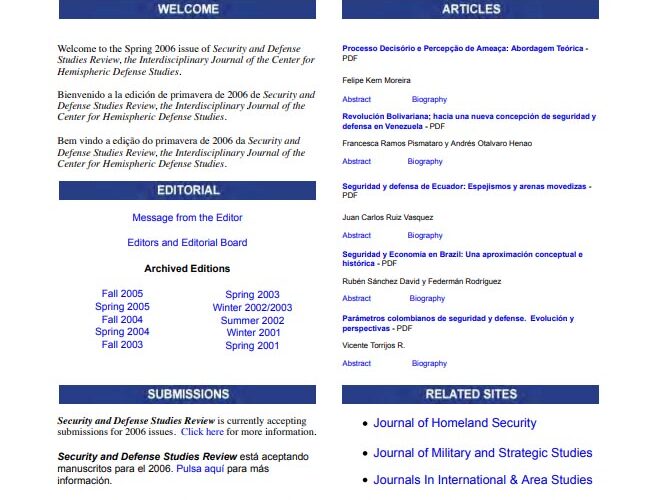
The author analyzes the evolution of Ecuador's security agenda from its historical roots to its most recent development during the conflict with Peru and the effects of the conflict on the Colombian border. The author maintains that Ecuador's security agenda was historically focused on the hypotheses of a conventional conflict with Peru and was based on its military forces playing a guardianship and social integration role, which helped the general populace identify with issues of security and defense. For these reasons, Ecuador's military forces sought to be essentially dissuasive against the military superiority of the country's neighbors. However, the conception of Ecuador's security and defense was to change direction in the late 1990s, as it turned its attention to the threats represented by the rise of Colombia's internal conflict on Ecuador's border. The weakness of the President Uribe Vélez' democratic security strategy on the Colombia-Ecuador border and the influence of the United States government will be fundamental in the formation of this new security agenda. Paradoxically, however, becoming involved in the Colombian conflict can have negative consequences for Ecuador's security. Although Ecuador denounces the detrimental effects of the Colombia plan for Ecuador's security, it seeks to simultaneously benefit from the Andean Regional Initiative that has similar purposes. The Ecuadorian state seems to have traditionally focused its security agenda on external threats, while the country's great internal, political and economic instability is perhaps the more significant source of insecurity that has also hindered the establishment of a policy for a coherent and lasting defense.
Read more
Using an approach that the author calls "hyper-realist" and a "transformational" perspective, this work attempts to establish the 16 parameters on which Colombia's security and defense system has been built and evolved. It also attempts to partially assess its impact on the dynamics of the most conflict-troubled strategic complex in the Western Hemisphere.
Read more